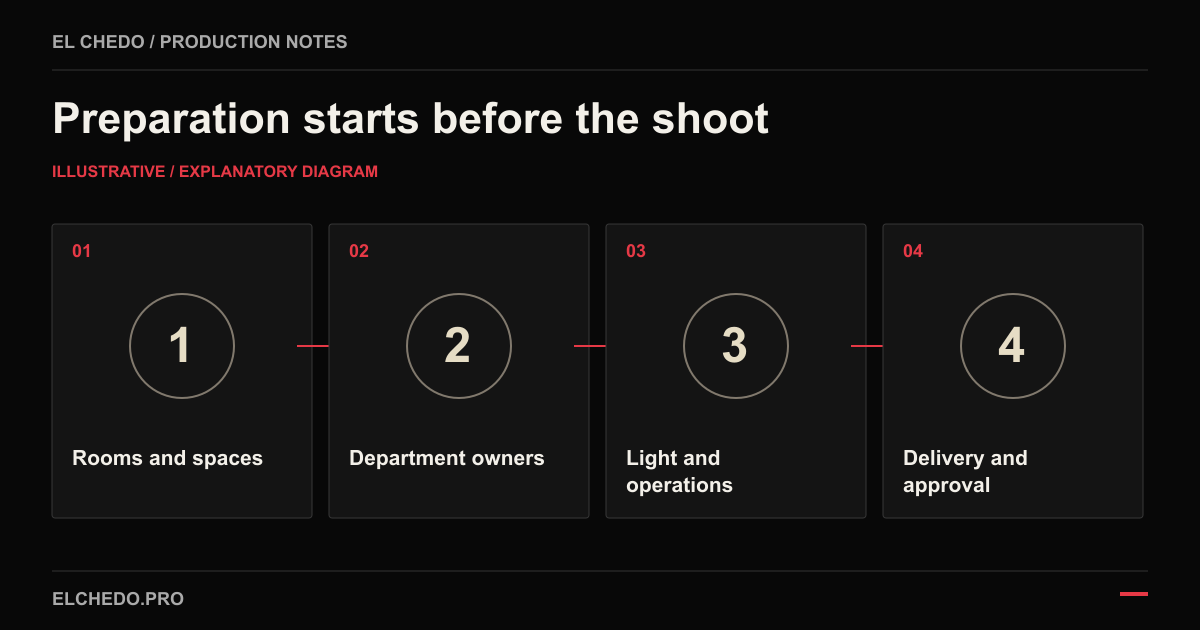
Some of the time lost on a shoot day can be saved before a camera is set up. If maintenance is still working in a supposedly ready room, or a restaurant shoot clashes with service, the schedule has to change. The aim is to have the next space ready at the right time, without expecting the entire hotel to be perfect at once. This guide gives marketing managers a preparation plan to share with departments.
1. Build the space list around room types
A hotel with a hundred rooms may not need a hundred separate rooms photographed. Start by listing room types, differences in layout and views, and renovated spaces. Flag significant differences between rooms sold under the same name. For each selected room, record its number, sales name, feature to be photographed and intended placement. This helps prevent a photograph being uploaded to the wrong room category.
Include the existing archive: completing a missing bathroom or balcony view may be enough, rather than photographing an up-to-date space again. If the scope is still unclear, use our hotel photography or brand film guide to separate priorities. Include details that answer booking questions, alongside the spaces that look attractive.
2. Give each department a clear handover task
Share tasks with the people responsible for each space, instead of expecting one marketing manager to prepare everything. One name and a time on each line are more useful than a long group conversation. The following list is a starting point and should be expanded around the hotel's operations.
| Department | Task to complete before the shoot | Check |
|---|---|---|
| Marketing and sales | Room names, priority spaces and publishing channels | Does the list match the sales page? |
| Housekeeping | Linen, curtains, bathrooms, glass and visible surfaces | Has the room had a final check before its shoot time? |
| F&B | Menu dishes, table settings and a service contact | Is food prepared close to its place in the shoot order? |
| Maintenance | Working light fittings, maintenance work and visible cables | Are any details missing or faulty in the frame? |
| Front office and operations | Access to spaces and information on guest activity | Does preparation and shooting fit guest movement? |
| Production team | Recce, light sequence, crew needs and a backup plan | Is there a ready time for every scene? |
When a space is ready, ask its owner to share a current phone photograph, alongside the status update. It does not replace the final photography, but it can reveal a missing bed cover, maintenance trolley or different table setting before the crew arrives. Take the check photograph from an angle as close as possible to the planned shoot angle.
3. Prepare the room as the guest will experience it
What appears in the frame matters as much as linen and curtain presentation. Avoid showing a welcome arrangement available only with selected packages as a standard feature of every room. Agree on a consistent setup for television screens, air-conditioning displays, balcony furniture and bathroom amenities. Discussing the same small details in every room slows the shoot down.
Check glass, mirrors and shiny surfaces from different angles. Allow floors to dry after cleaning, then make a final pass once equipment and staff have left the room. Confirm that the selected room really belongs to the category being sold. Keep files labelled with the correct room and view, rather than combining different views into a single room experience.
4. Let light and operations shape the day together
In Antalya, outdoor shoot order should consider more than when an area is empty. Facade direction, shadows and activity throughout the day are assessed together during the recce. Which space suits morning light varies by property. The example below is an illustration of how to connect spaces in a schedule, rather than a real client programme or a fixed shoot duration.
If a room is delayed, the crew should be able to move to a prepared alternative. Discuss who will appear in scenes with people, and how the space will be arranged, in advance. The hotel's operations contact should be reachable on site. Share a programme that includes preparation, moving equipment, returning spaces to use and short checks, alongside the shooting times.
5. Explain the file requirements before shooting
The website, booking channels and social media may need different compositions. Show the crew the actual pages and placements. List the main room photograph, details, vertical compositions and space for text separately. Avoid assuming every photograph will crop smoothly to every ratio. If video is also wanted on the same day, schedule that requirement separately.
File names should clearly identify the room type, space and approved version. Use one source for facility names and room descriptions. During approval, view sample files on the actual page and on a phone: an attractive thumbnail may hide an incorrect gallery match. Marketing should decide which selection goes to which channel before delivery.
6. Close the final checks in one list
Download the hotel shoot checklist by department. Add your spaces and record the owner, ready time and status on each line. On the shoot morning, discuss outstanding tasks: clarify delayed spaces and alternatives without repeating every completed preparation.
- Selected rooms and spaces match current sales information.
- Every department has an owner and a ready time.
- F&B preparation, light sequence and guest movement have been considered together.
- There is a backup space for delays or weather changes.
- Compositions, file names and delivery uses are clear.
- The final selection has an approver and a scheduled check.
When planning hotel photography and video production with El Chedo, share your current website, room types and renovated spaces. That information makes the difference between photographing the entire hotel again and completing specific gaps visible at the first conversation.