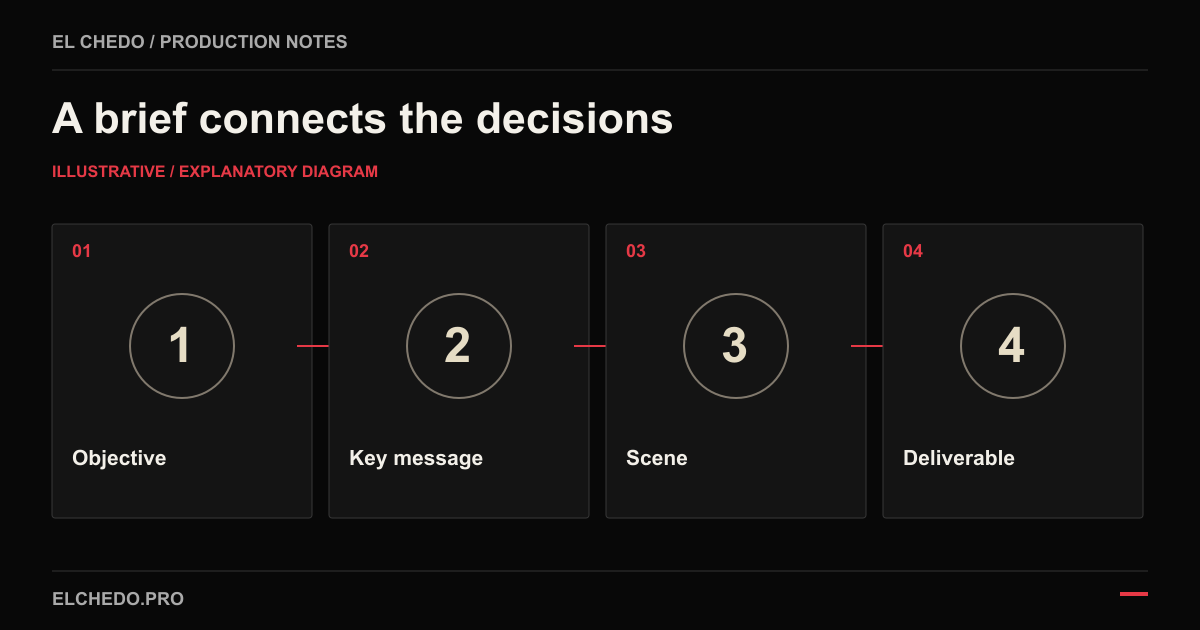
'Make it premium, and let us use it on social media too' can start a conversation, but it is insufficient for preparing a proposal. A crew could derive very different scripts and deliverables from that sentence. A brief is not a test requiring you to write the creative idea first. It is a way to share why the work is needed and what success would mean. The example below represents neither a real client project nor campaign results.
1. Turn the business goal into a viewer's question
Start with 'What do we want to change after this film?' Introducing a new product, explaining how an existing one works and helping sales staff demonstrate a feature are different needs. Select one primary goal. If there are several, rank them: trying to give all of them equal weight in one film can blur the main message.
Describe the audience beyond age or city. Do viewers already know the product? What do they need to understand before buying? Where and in what situation will they see the film? Record a real product feature or service detail that can support the message on screen. Keep an unverified benefit as an open question instead of turning it into a firm promise.
2. Review a completed brief example
| Field | Completed example |
|---|---|
| Business goal | Explain how the new desk lamp works in a small workspace. |
| Viewer and question | Someone working at a small desk at home: how much space does it take up when unused? |
| Single main message | After use, the lamp folds for storage that occupies less desk space. |
| Evidence to show | The actual sample opening, providing light and folding; accurate dimensions. |
| Tone and boundary | A simple, warm workspace. Do not show touch controls the product does not have. |
| Publishing channels | Product page and social advertising placements. |
| Requested deliverables | One 20-second main edit and one 10-second short edit; horizontal and vertical adaptations, subtitled and clean versions. |
| Budget and schedule | The brand will provide a budget range and publication date; sample delivery and approval days will be agreed together. |
| Approval | One brand contact, with a separate named person checking product accuracy. |
This provides more information than 'a cinematic desk lamp advertisement', while leaving the script open to the creative team. They can communicate the same message through different scenes and edits. For example, a hand folding the product is an idea that follows from a demonstrable message. The brief's role is to explain which need a camera move would serve, rather than prescribe that move.
3. Separate deliverables by duration, ratio and message
Expand 'one film and social versions'. How many distinct edits, which durations, which screen ratios, which languages and which subtitle options are needed? A vertical adaptation of the main film differs from a new short film focusing on another product feature. You can request both; the proposal should show them as separate items.
Include an example of the intended placement. Indicate areas occupied by a headline or button. For placements often viewed without sound, ask for the message to work through images and text. If product photographs, covers or still campaign images are needed, add them to the deliverables rather than treating them as automatic by-products of the film.
4. Share the assets and constraints affecting production
Supply the current logo, brand colours, correct product sample, dimensions and existing imagery with the brief. Explain what you like about a reference video: lighting, pace, set or storytelling. Avoid turning a reference into a request to copy all its features. List required details and excluded elements, such as an old packaging version, separately.
Sample arrival, location availability and the support the brand can supply affect the schedule. The choice between filming, AI and a hybrid approach can remain open; state that it is a decision requiring the crew's assessment. If the method is already fixed, explain why. A clear budget framework helps the team develop an idea at a feasible scale.
5. Plan approvals and revisions before production
Name one person responsible for brand feedback. They should consolidate internal comments and resolve conflicting notes. If product accuracy and creative approval belong to different people, state their roles. Put decisions about the script, visual approach, first edit and final version into the schedule, with the time each decision is needed.
Changing an approved lamp colour after the shoot may be a different request from shortening a shot in the current edit. Ask the team to explain revision scope. Work back from the publication date, including the brand's feedback time. Once proposals arrive, use our guide to comparing commercial film quotes to assess the same scope.
6. Complete the template and flag open questions
Download the commercial film brief template. Start with the fields you can answer in one sentence. Where an answer is unknown, write 'recommendation needed' or 'product team to confirm', instead of inventing certainty. The first meeting should close those open lines and turn them into production decisions.
- Are the primary goal and viewer's question clear?
- Does the single main message have evidence that can be shown?
- Are deliverables separated by duration, ratio, language and edit?
- Have product assets, budget framework and schedule been shared?
- Are the feedback owner and approval days defined?
Bring this first draft to a conversation about commercial film production with El Chedo. The brief does not need to be perfect. Once the goal and open questions are visible, the creative proposal and quote can address the same need.